
About Montessori
Maria Montessori was not looking to revolutionize education. She was looking at children and allowing what she saw to guide her. In 1907, she opened her first classroom for young children in a low-income neighborhood in Rome. She called it Casa dei Bambini ("The Children's House").
What happened inside that small room changed the course of early childhood education forever. Given a prepared environment, purposeful materials, and the freedom to choose their own work, children as young as three demonstrated a capacity for deep concentration, independence, and joy in learning that astonished everyone who witnessed it. Montessori did not invent a curriculum. She observed the child, and the method followed.
More than a century later, the approach she developed remains one of the most thoroughly researched and widely respected educational philosophies in the world. The Montessori Method is built on a simple but profound belief: the child possesses a natural drive toward growth, and the adult's role is not to direct that drive, but to support it. In a Montessori classroom, the environment itself is the teacher. Materials are beautiful, purposeful, and sequenced with extraordinary care. Children move freely, choose their work, and progress at their own pace through a curriculum that spans mathematics, language, the senses, practical life, and the cultures of the world.
At Casa dei Bambini Montessori School, we work to carry that name forward with intention. Like that first classroom in Rome, our school is a house that belongs to the children- a place where they are trusted, respected, and are free to become fully themselves.
-
In the Montessori Primary classroom, mathematics is not something a child is taught; it is something a child discovers. Through a carefully sequenced set of beautiful, hands-on materials, children as young as three begin building a concrete understanding of quantity, place value, and the four operations long before they encounter symbols on a page. Golden beads reveal the decimal system in the child's hands. The Stamp Game makes four-digit addition tangible. The bead chains make skip-counting a physical, sensory act. By the time a child at Casa dei Bambini reaches abstraction, the concept lives in their body as much as their mind, and that understanding stays with them.
-
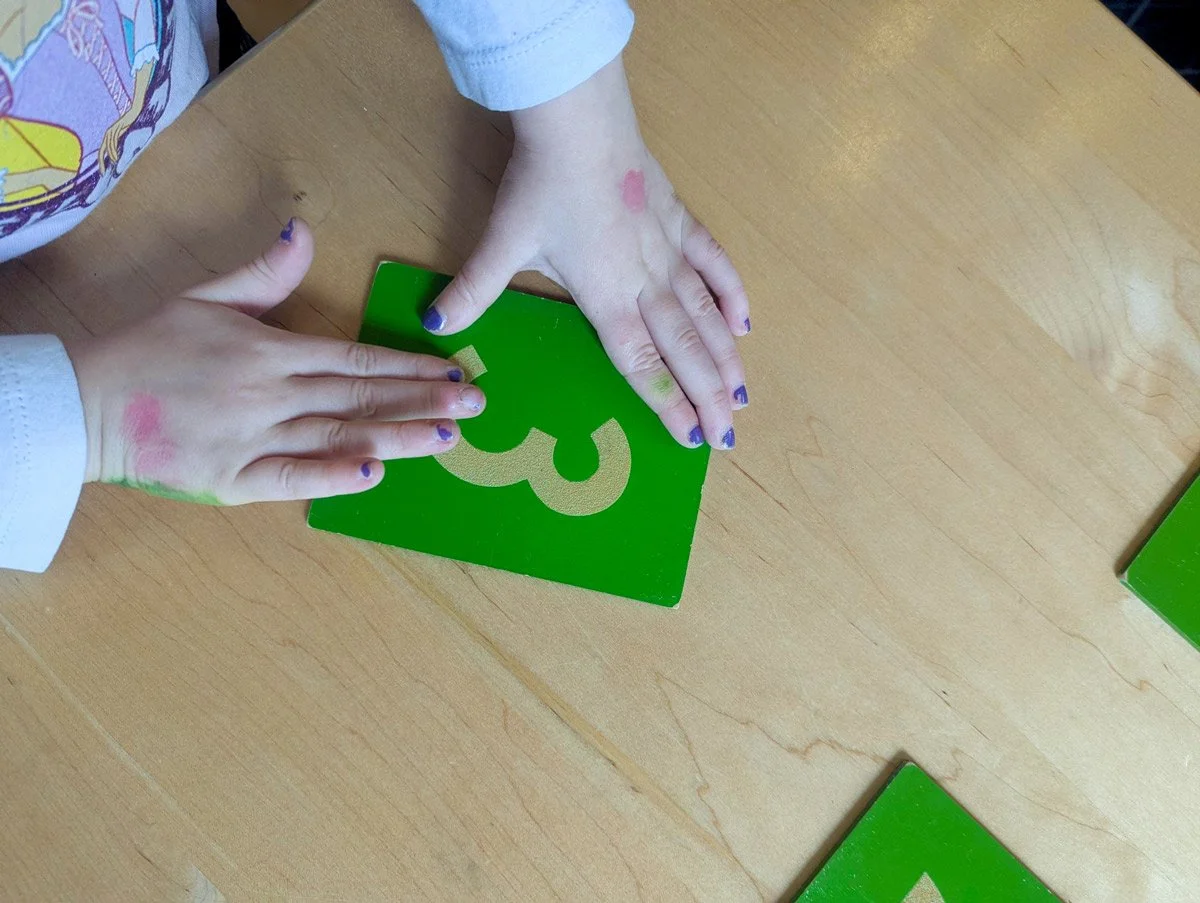
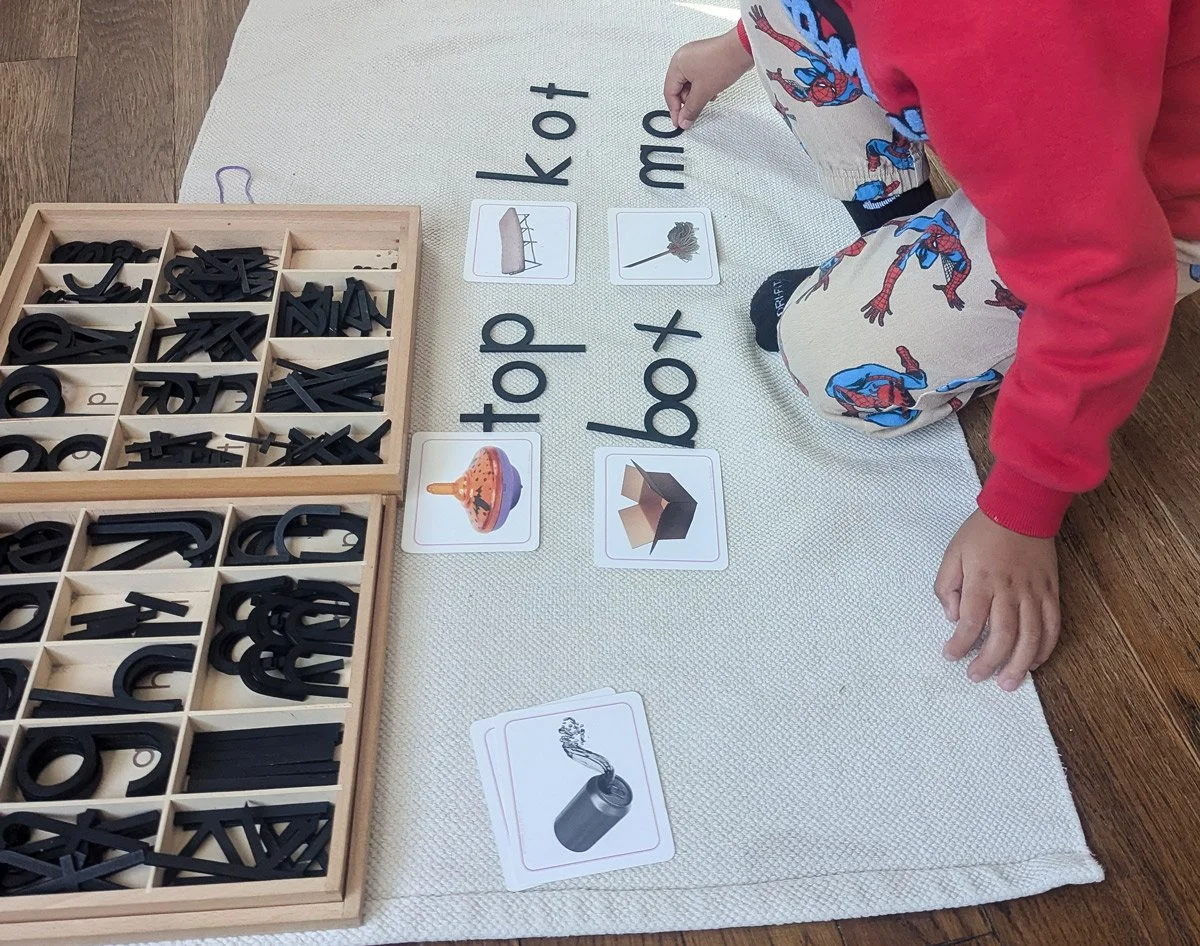
Language surrounds everything in our classroom - in conversation, in story, in the careful naming of the world. Through the Montessori sequence, children move from spoken language to symbol, from symbol to reading, and from reading to writing in a progression that honors how language naturally unfolds in the young child. Sandpaper letters introduce sounds through touch. The Moveable Alphabet allows children to compose words and stories before their hands are ready to write them. Reading emerges not as a skill to be drilled, but as a revelation
-
Before a child can reason abstractly, they must know the world through their senses. The Sensorial area of the Montessori Primary classroom is devoted entirely to the work of refining and ordering perception through materials that isolate a single quality at a time. The Pink Tower builds awareness of dimension. The Color Tablets teach the eye to discriminate shades. The Sound Cylinders tune the ear. The Baric Tablets develop sensitivity to weight. Each material is an invitation to observe more precisely, to notice what was invisible before. This work is not a precursor to "real" learning -it is real learning and is foundational to everything that follows.
-
Practical Life is where the Montessori classroom begins and where its deepest values are most clearly expressed. These are the activities of real daily living: pouring, folding, sweeping, polishing, caring for plants, preparing a snack, greeting a visitor with grace. To an observer, they may look simple. To a child, they are the work of becoming capable, independent, and at home in the world. Practical Life exercises develop concentration, coordination, and the kind of purposeful attention that carries into every other area of the classroom.
-
We introduce children to the world not as a subject to study, but as a home to know. Through maps, puzzles, flags, and artifacts, children in our Primary classroom encounter the continents, landforms, and peoples of the Earth with a sense of wonder rather than distance. Our cultural material is built on Maria Montessori's conviction that education for peace begins with education for understanding and that a child who knows the world is more likely to love it. Science, history, music, art, and botany all live within area of the classroom.
Contact us
Interested in working together? Fill out some info and we will be in touch shortly. We can’t wait to hear from you!